Showing posts with label slash goggles. Show all posts

Tuesday, April 17, 2012

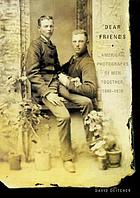
booknotes: dear friend

A colleague of mine at work recently passed along a copy of David Deitcher's Dear Friend: American Photographs of Men Together, 18401-1918 (Abrams, 2001). This is a fascinating photo essay book which gathers together early American portraits of "men together," captured by the camera in intimate poses. For the most part, these are formal portraits, the individuals arranged (or arranging themselves) with body language that reads to us, today, as "couple." Deitcher, an art historian and self-identified gay man, became intrigued with this genre of photographs after a student who attended one of his guest lectures showed him several examples of such images the student had purchased at flea markets. Intrigued by the ease with which the subjects seemed to pose together, their bodies intertwined, Deitcher began to search for other examples of nineteenth-century images of male couples or male groups posing together with affection. Dear Friend reproduces many of these examples, most of them of anonymous subjects, the specific context of their creation lost to time.

Accompanying the images is Deitcher's commentary, telling the story of his quest for the photographs and their modern-day reception, as well as analysis of the images both as art and historical artifact. "It is one thing to describe what such photographs represent (for the gay man who collects them with such avidity), quite another to claim to know with any degree of historical precision what it is that they depict" (76). Throughout the book Deitcher attempts to keep in tension -- not wholly successfully -- the notions that these images can, and do, represent to modern queer individuals the universality of same-sex desire while at the same time we can never know with certainty the quality of emotion that brought these photographic subjects together in the frame. At times, Deitcher over-eggs the cake in his attempt to push back against historians' insistence that the past is a foreign country. Feeling same-sex desire is erased or denied in scholars' formulation of "passionate friendship," he pushes us to imagine that at least some of these photographs do, in fact, depict men who were in each others' pants on a regular basis. This I'm very willing to believe; I'm less willing to see historians of sexuality as homophobic in their insistence that we back away from inscribing twenty or twenty-first century notions of sexual identity onto the past.

Nonetheless, this is a fascinating collection of images that encourage us to historicize our own notions of heteronormative behavior, as well as challenge our collective memory of a straight past.

Tuesday, January 31, 2012

booknotes: inseparable

Recently, thanks to Danika the Lesbrarian, I became aware of novelist Emma Donoghue's Inseparable: Desire Between Women in Literature (Alfred A. Knopf, 2010). A perfect read for the winter holidays! While I've long been aware of Donoghue's nonfiction work as a literary historian, my previous encounters with her work have been her more widely-read fiction -- specifically the cross-cultural love story Landing (2007) and just this month Kissing the Witch (1997), a collection of re-visioned fairy tales "in new skins." I really enjoyed my foray into her nonfiction writing, and am looking forward to checking out her other works of literary-historical exploration.

Inseparable is a fairly quick -- yet still substantive -- read, charting the themes of "desire between women" in Western literature from 1100 to the present. I recently wrote a disappointed review of Phyllis Betz' The Lesbian Fantastic, a similar project of analysis which focused specifically on lesbian genre fiction. The biggest problem I identified in Fantastic had to do with the issue of defining "lesbian" authorship, a question which Donoghue jettisons immediately in her introduction by observing, "I do not much care who wrote [stories of desire between women], nor why. What interests me is the stories, and the ways they connect" (7). She also cautions against reading her work in search of historical examples of lesbians past: "I will be looking at relations between women, rather than the more historically recent issue of self-conscious sexual orientation ... The past is a wild party; check your preconceptions at the door" (5). The result is a delicious and illuminating romp through nearly one thousand years of literary tradition in which Donoghue identifies six distinct narrative clusters: (1) "travesties," narratives where cross-dressing by women and/or men which results in a same-sex pair, (2) "inseparables," passionate friendship between two women in the face of forces attempting to separate them, (3) "rivals" in which a man discovers the rival for his beloved's affections is another woman, (4) "monster" lesbians who seduce and destroy an innocent, (5) "detection" of the criminal sort results in the discovery of a same-sex relationship, and (6) coming "out" narratives in which a girl or woman discovers her capacity for same-sex desire and finds her life irrevocably changed as a result.

I was tickled (and somewhat abashed) to realize how many of these durable themes I'd unwittingly picked up and re-tooled for my f/f slash fiction involving Sybil and Gwen from Downton Abbey. A young upper-class woman seduced by her maid? Check. The awakening of same-sex desire as a pivotal moment of personal growth? Check. The haven of an urban environment/queer subculture? Check. The attention to creating a domestic "gone to housekeeping" environment for one's protagonists? Check. The devil-may-care lesbian, who understands her precarious social status, but embraces her desire anyway? Check. The incorporation of early sexological terms and frameworks in the characters own self-understanding? Check. I could go on. It's sort of comforting even as it is a little embarrassing, to realize how in debt we all are to literary tradition for our own vocabularies of passion and intimacy.

What I most appreciate, in the end, about Donoghue's expansive approach to reading "desire between women" in literature is that her reading as a critic mirrors the way so many of us read as, well, ordinary readers. I understand the social-historical forces that have led people to bemoan the invisibility of "lesbian" literature, or the dearth of queer characters in fiction, and the preponderance of unhappy endings to the fictions that do exist. At the same time, I think there is a place to recognize the way in which readers engage with -- and retool -- what literary narratives are available to them. The passion expressed before the final death scene may be more important to the reader than the tragic ending. The deux ex machina of a last-minute gender-swap (so that the lovers can marry/procreate) often matters little, in Donoghue's examples, to the lovers themselves whose passion for one another is unshaken by the reveal of the cross-dressing character's "real" sex. By setting aside identity categories as a selection tool, and instead focusing on the words and actions of actual characters, Donoghue shows us how persistently women's desire for other women has appeared in Western literature, even as the writers and readers of such literature denied knowing such passion could, in fact, exist.

What this suggests, intriguingly, is that on one hand we (at a cultural level) realize and acknowledge that same-sex desire and intimacy exists ... while on the other we fairly consistently write around it, insisting it is something unspeakable, invisible, and materially impossible. Sexual desire between women is, in other words, doing a bang-up job of hiding in plain sight. Obviously stories about same-sex desires and relationships between women per se do have more cultural legibility in the early twenty-first century than they have been in previous eras. Yet reading Inseparable I couldn't help but think of my own frustration in locating f/f fan fiction, whereas m/m pairings are so ubiquitous that the term "slash fiction" is often used interchangeably to mean the pairing of two male characters in a sexual relationship. While Inseparable makes the persuasive argument that women's passion for one another is there if only we look for it, the outstanding question in my mind is why it seems so perennially difficult for us to see.

Tuesday, January 3, 2012

movienotes: calamity jane

Calamity Jane (Day) and Wild Bill Hickok (Keel)*

When Hanna and I were visiting her folks back in December, we decided to watch the old VHS copy of Calamity Jane (1953) starring Doris Day and Howard Keel that we found in their video collection. In our defense, may I point out that a) we love making fun of crap movies, and b) Seven Brides for Seven Brothers was a childhood favorite of Hanna's, and c) when I was about eight the original Broadway cast recording of Annie Get Your Gun starring Ethel Merman was where it was at as far as I was concerned. I was the proud owner of a vinyl record (my very first!) and would make my best girl friend at the time play Frank Butler to my Annie Oakley as we sang, "The Girl That I Marry" and "Anything You Can Do I Can Do Better." To this day, I feel our relationship fell apart at least partially because she wanted a girl who was "soft and pink as a nursery" while I was more of a "Doin' What Comes Natur'lly" kinda gal.

Anyway, so we decided to watch Calamity because of these things. And obviously we were anticipatory of the cringe-inducing depiction of Native Americans, the weak plot (this was no Deadwood), and to some extent the weak music and lyrics (Sammy Fain and Paul Webster are no Irving Berlin). What we didn't anticipate was the lesbian (sub)text and the total confusion in the heteroromance department.

See, here's the deal. As the film opens, Calamity Jane and Bill Hickok are pals living and working in Deadwood. They clearly see one another as besties, a situation which lasts through to the end of the film where their platonic friendship is required to morph into a romantic one in order to satisfy the demands of the marriage plot. Until the last-minute deus ex machina, however, Jane overtly professes desire for Lt. Danny Gilmarten (Philip Carey), stationed in Deadwood, and simultaneously acts out a courtship and marriage scenario with the other leading lady, Katie Brown (Allyn McLerie). Katie is a dance hall singer/stripper who Calamity Jane brings to Deadwood from Chicago to help the local saloon owner satisfy his customers. While Katie's role in the movie is very obviously scripted to teach Jane how to be feminine, their relationship plays out as a romance from the very start. When Jane goes to meet Katie backstage in Chicago, Katie first reads Jane's body language and dress as male, and reacts as if Jane is a male intruder. Even after Jane clears up the misconception, the two continue to act out a butch/femme dynamic as Jane shepherds Katie to Deadwood (protecting her from hostile Indians), defends her honor at the saloon, and invites Katie to move in with her. The two set up housekeeping and Katie invites Jane to learn how to behave like a "proper" woman. Interestingly enough, despite Jane's transformation from "one of the boys" into a feminine girl, she persists in wearing her buckskin outfit in all of the scenes not focused on her transformation -- her femininity doesn't require skirts.

The romantic cross-currents in the film are terribly confused -- in no small part because the Jane/Katie pairing follows the classic girl-civilizes-boy courtship arc, except that the two characters are both women. The two are initially at odds, but find aspects of the other to appreciate, and settle into a domestic arrangement. Obviously, however, the film-makers needed the marriage plot they'd initiated to end in heterosexual marriage. So: re-enter Hickock and Gilmarten, who come to the women's idyllic cabin in the woods to woo (you guessed it) Katie Brown. Katie, knowing Jane desires Danny, resists initial advances but accepts an invitation to a local ball on the condition that Jane be invited as Bill's date. At this point I count three romantic triangles: (1) Katie and Jane in rivalry for Danny, (2) Danny and Bill in rivalry for Katie, and (3) Bill/Danny and Jane in rivalry over Katie.

Obviously, the solution would be for them all to move to Planet O. But barring that, the scriptwriters obviously felt they needed to resolve the plot in a timely and heterosexual manner. So Katie, despite earlier protestations, takes up with Danny at the ball -- causing Jane to storm off in jealousy. Jane later confronts Katie in the midst of Katie's stage show, demanding that she leave town. Bill helps Katie make Jane look foolish (in order to teach her a lesson) and then at the eleventh hour professes his love for Jane. Jane, having resolved her jealousy by transferring her affection for Bill, rides off to collect Katie from the departing stagecoach and the two straight couples have a joint wedding just before the credits roll.

The essential confusion of the show's narrative, I feel, can be summed up in an an exchange between Bill and Jane in which Bill suggests to Jane that her rage at Katie is caused by "female thinking," which clouds her rational mind and stops her from thinking clearly. Since the ostensible thrust of the narrative to that point was to move Jane from an essentially masculine position to a feminine one (from which she can be paired with Bill), the last-minute accusation of too much femininity highlights the nonsensical nature of the plot. Only by reclaiming her active, masculine position in the narrative (riding off in her buckskin to retrieve Katie from the retreating coach), can Jane reclaim her honor and win her place by Bill's side ... even as all of the cues of the narrative put her and Katie together as a butch/femme couple.

In short, don't watch Calamity Jane for the music, the Wild West themes, or the heteroromance. Instead, watch it for the lesbian relationship hiding in plain sight. As Hanna put it, "This isn't subtext, this is just plain old text."


*image via