Showing posts with label social justice. Show all posts

Tuesday, May 29, 2012

booknotes: joining the resistance

Psychologist Carol Gilligan is something of a controversial figure in feminist circles. Her work on young women's psychological health (In a Different Voice) is widely read and widely criticized for dramatizing adolescent girls' experience in unhelpful, alarmist ways; I once had a Women's Studies professor, herself a psychologist, react to the news I was reading Gilligan's The Birth of Pleasure (Knopf, 2002) with caution, pointing out gently that her theories often seemed to rely on assumptions about gender essentialism that sat uncomfortably with many.

As an instinctive anti-essentialist (at least when it comes to gender) I remember being a bit surprised that Gilligan's arguments would be taken that way -- since that wasn't the sort of psychological landscape I saw her outlining in Pleasure. Weaving together reflections on canonical female truth-tellers (drawing on her background in English literature) and her psychological research, Gilligan is primarily interested in how individuals -- of any gender -- speak or stay silent about what they know. Drawing on theories of developmental psychology, psychoanalysis, a feminist analysis of the kyriarchy, Gilligan argues that human beings are born into the world with a full range of psychological resources which are then curtailed by gender policing which in turn causes psychic trauma.

Drawing parallels between preschool age boys and middle school age girls, Gilligan suggests that at points when growing beings are initiated into new levels of patriarchal control, we see increased instances of acting-out and destructive behavior (toward the self and others). Because girls experience this trauma at a later developmental stage than boys, she argues, women as a population are more likely to be able to articulate what they have lost in the initiation process, and to have the resilience to push back successfully. Men, she theorizes, can often identify the trauma of being forced into male-stereotyped behavior, but because it happened so early in childhood have a very difficult time accessing memories of their humanity before certain ways of being were rendered off-limits due to gendered expectations.*

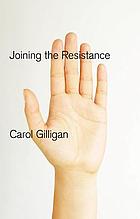
Which brings us to Gilligan's latest work, a slim volume titled Joining the Resistance (Polity Press, 2011). Half reflection on her body of work, half call to action, Resistance shares some of the highlights of Gilligan's research in an accessible way and makes a passionate appeal for re-connecting with the parts of our humanity that the oppositional gender-binary has robbed from us. "Our ability to love and to live with a sense of psychic wholeness hinges on our ability to resist wedding ourselves to the gender binaries of patriarchy," she argues, in language that should make any feminist worth her salt jump for joy (109). This recalls the research Phyllis Burke cites in Gender Shock which suggests that the individuals least invested in maintaining oppositional gender roles are those most adaptive and resilient in the face of hardship and trauma.

Gilligan, following such humanist psychologists and philosophers as Eric Fromm, Abraham Maslow, and Carl Rogers, pushes us to reconsider our assumptions concerning the fundamental nature of humanity. While resisting any simplistic arguments that human nature is "good" (vs. "bad"), she suggests that we might reconsider widespread assumptions about human self-interest and cruelty. We might do well, she suggests, to listen to those who resist inflicting violence and trauma -- and rather than frame them as exceptions to the rule, think of them as survivors of an indoctrination process:
I am haunted by these women, their refusal of exceptionality. When asked how they did what they did, they say they were human, no more no less. What if we take them at their word? Then, rather than asking how do we gain the capacity to care, how do we develop a capacity for mutual understanding, how do we learn to take the point of view of the other or overcome the pursuit of self-interest, they prompt us to ask instead: how do we lose the capacity to care, what inhibits our ability to empathize with others, and most painfully, how do we lose the capacity to love? (165).
With this as her guiding question, Gilligan challenges us to think about how we might re-formulate education (and society more broadly) to support -- rather than destroy -- "the capacity to love." This brings together notions of education, citizenship, social justice, and peace activism, in a combination that will be familiar to many progressive, counter-cultural educators who have been arguing for holistic education since at least the mid-1960s. One of my disappointments with Resistance was that Gilligan didn't acknowledge or engage with that counter-cultural community (of which there is a fairly active virtual and real-life network here in the northeast United States which she calls home!) within the text. I would have appreciated some evidence that she is at least aware of the dissident educators of the past sixty years (or more) who have insisted that this "feminist ethic of care," this more holistic vision of humanity, be central to our pedagogy as we nurture into adulthood the next generation(s). But one can't have everything!

I'll leave you with one of my favorite passages from the book, which I posted on Tumblr last week with the comment that, while "secure relationships" are obviously not limited to parent-child connections, this is a strong argument that if we want to strengthen marriage and families, we ought to be legalizing (and advocating for!) poly relationships:
The ideal environment for raising children turns out to be not that of the nuclear family but on in which there are at least three secure relationships (gender nonspecific), meaning three relationships that convey the clear message: 'You will be cared for no matter what.' (53)
I also want to point out that this is a really strong argument for those of us who plan on not parenting to get involved with people who are parents. Because by being a "secure relationship" person in the life of a child, or children, even (especially?) when they aren't our direct dependents, means we're creating a world in which more adults will be psychologically whole, secure persons. And that's a better world for us all.


*At the very end of Resistance, Gilligan brings in recent research on adolescent boys, which suggests that they, like the adolescent girls whom Gilligan has spent her professional life studying, experience the dissonance and limitations of patriarchy. I'd love to see her (and others) develop this further.

Tuesday, April 10, 2012

booknotes: an april round-up

So here are a few books I've read recently that I don't have the oomph to give full reviews. The usual disclaimer: The brevity of my review doesn't necessarily indicate the worthiness of the book.

Burke, Phyllis | Gender Shock: Exploding the Myths of Male and Female (Anchor Books, 1996). When Phyllis Burke's son was born, she and her partner found themselves fielding concerned questions about how two lesbians could raise a son without male role models in the family. Burke began by defending her family by talking about all of the men whom her son would connect with in their extended kinship network, but as time went on she found herself wondering why the gender of one's parents should matter when it came to modeling adult behavior. This question led her to explore the scientific and cultural world of normative gender assumptions. Gender Shock's central body of evidence is case histories of children treated by mental health professionals for gender deviance, so consider yourself warned when it comes to rage-inducing narratives in which children are brow-beaten and manipulated into giving up everything from cross-dressing to care-taking, an "excessive" interest in sports or an inclination toward the culinary arts. While some of the most egregious examples of abuse come from the mid-70s and early 80s, Burke makes the point that even in the early 90s children were still being punished for sex and gender deviance, particularly when such non-normative behaviors intersect with other supposed markers for criminality (poverty, non-whiteness, rebelliousness, foster care). While my lay impression is that the professional climate has somewhat improved since then, if anything, the moral panic around children's performance of gender has intensified since the turn of the millennium. Worth reading for those with a professional and/or personal interest in the topic of gender policing.


Kline, Wendy | Bodies of Knowledge: Sexuality, Women's Health and the Second Wave (Chicago University Press, 2010). Kline's brief history of women's health activism during the mid-twentieth century is well researched and thoughtfully written. Rather than attempting a survey of the women's health movement, Kline uses her five chapters to examine specific moments of activism and activist groups: the Boston Women's Health Book Collective, the movement for self-directed pelvic examinations, Chicago-area abortion activism, patient action around the use of Depo-Provera shots as a birth control method, and finally the rise of modern midwifery. Much of Kline's research was done in Boston-area archives, and her case studies are focused in cities along the East Coast and Chicago. This case study approach allows from some fascinating essay-length treatments of specific interactions between feminists and medical professionals / the healthcare industry. Across the chapters, Kline articulates common themes such as the feminist insistence that women were authorities on their own embodied experience, and suspicion of the healthcare industry and medical professionals who were predominantly men, many (though not all) of whom had little time for feminist critiques of medical practice. Discouragingly enough, Kline's central question is why feminist activism around health care was largely unsuccessful in changing mainstream practice. While the book as a whole begs for elaboration on the topic, hopefully Kline's work will serve as inspiration for further research.

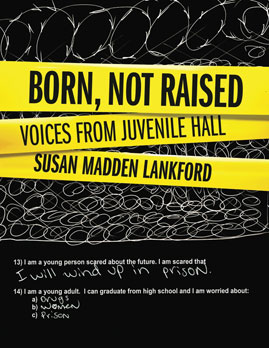
Lankford, Susan Madden | Born, Not Raised: Voices from Juvenile Hall (Humane Exposures, 2012). Voices is the third volume in a trilogy of photo essays in which Lankford documents the experiences of marginal populations: the homeless, women in prison, and now incarcerated children. The book is a collage of voices, including photographs and reproductions of worksheets and essays completed by the youth Lankford worked with in prison alongside Lankford's own reflections, transcribed interviews, and commentary by mental health professionals and workers within the system.The historian in me was frustrated at times with what felt like heavy-handed analysis. The adult commentary meant to interpret young peoples' words and pictures for the reader smacked of condescension toward youth and reader alike. I felt sometimes that the project could have benefited from community-based analysis (e.g. the young people synthesizing and analyzing their experience, and perhaps utilizing the project as a springboard for social change. At the same time, I appreciate Lankford's empathic approach, and her liberal use of primary source materials which allow us some type of access to the inner lives of the marginalized and vulnerable.

Walker, Nancy A. | Shaping Our Mothers' World (University Press of Mississippi, 2000). An English professor, Walker takes an American Studies approach to understanding popular mid-twentieth century women's magazines (i.e. Ladies Home Journal, Good Housekeeping, McCall's, Vogue, Mademoiselle) as expressions of both dominant cultural understandings of the domestic and the often ambivalent or contradictory experiences of women themselves negotiating what it meant to be a wife, mother,daughter, unmarried woman, household member, and so forth. She locates these widely-circulated magazines at the hinge-point of "mass culture" (passively-consumed) and "popular culture" (in which one is an active participant). Long-vilified by mid-twentieth-century feminists for disseminating sexist ideals of femininity and family life, Walker suggests that these magazines were far from unified in their ideologies of gender, and that readers often talked back to the editorial, article, and advertising content. I'm only about halfway through this one, but I appreciate Walker's thoughtful re-examination of a popular medium we all think we "know" to have been neo-traditionalist and kyriarchical.